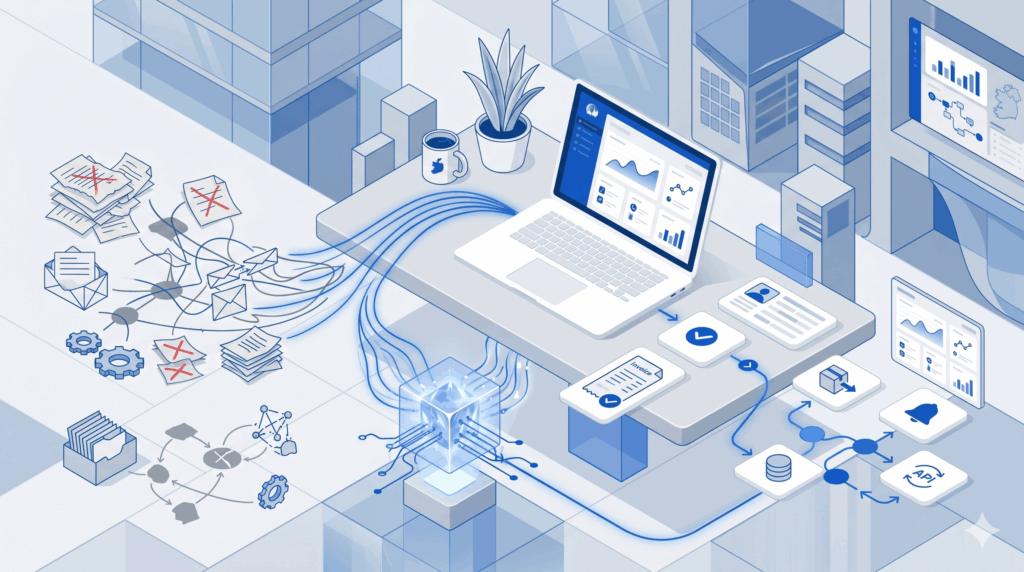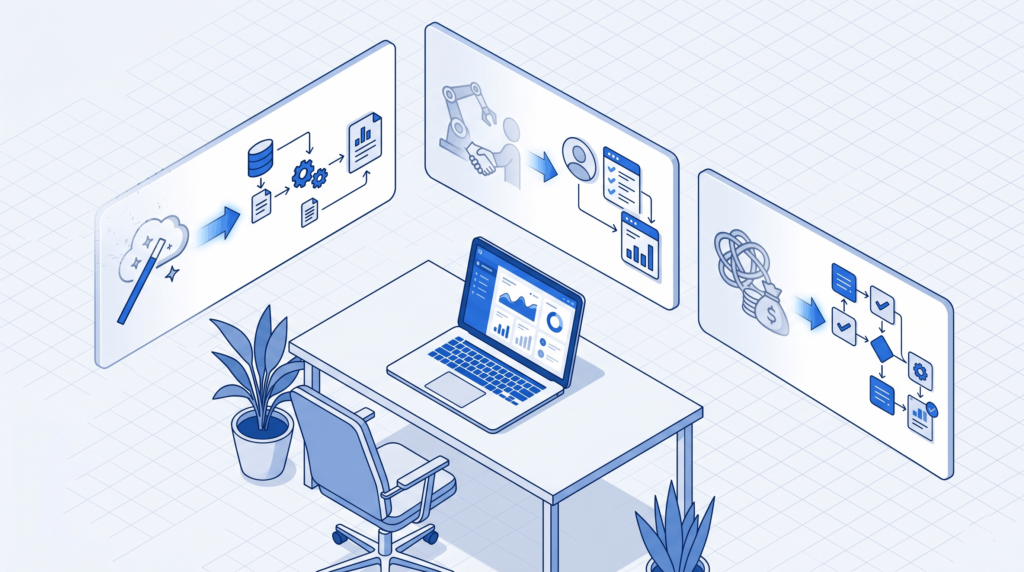
Most AI myths for small businesses start with the same mistake: people assume AI only matters if you have a big budget, a technical team, and months to spare. That is not how most Irish SMEs actually work.
You are probably trying to save time, reduce admin, and stop good people from being stuck doing repetitive work. You may also be wondering whether AI is worth the effort, or whether it is just another buzzword that will create more noise than value. If that sounds familiar, the real answer is usually simpler than the hype suggests, especially when the first step is framed around a practical business problem rather than a shiny tool. A useful next read is AI automation for Irish startups and SMEs because it shows how the idea works in real workflows, not just in theory.
This article will clear up the biggest myths, show where AI does help in real business settings, and explain how an Irish business can start small without taking a blind leap. By the end, you will know what AI can realistically do, what it cannot do, and what a sensible first step looks like for your team.
AI myths for small businesses: what is actually true?
AI myths for small businesses usually fall into three buckets: size, people, and setup. Once you strip away the noise, the real question is not whether AI sounds impressive. It is whether it removes a specific bottleneck in your business.
Here are the three claims worth challenging:
- AI is only for big companies, which ignores how many small tasks can be improved with a narrow workflow.
- AI will replace your people, which misses the fact that the best systems still need human judgement.
- You need perfect data and a huge budget first, which stops many useful projects before they begin.
That is the pattern Irish SMEs should care about, because the best AI projects are usually the smallest ones with the clearest outcome. Once you know which myth is getting in the way, the practical answer becomes much easier to see.
Myth 1: AI is only for big companies
That is one of the most common myths, and it is also one of the least helpful. Small businesses often get more immediate value from AI because they feel the pain of admin, slow follow-up, and manual data entry much more sharply.
Think about a Dublin accounting practice that spends too much time drafting email replies, sorting incoming requests, and pulling information from multiple systems. A simple AI workflow can reduce that friction without replacing the accountant’s judgement. That is why Cozmotec’s AI development services are often aimed at one clear task first, not a giant company-wide rollout.
Small businesses usually benefit most from AI in tasks like:
- Drafting first-pass responses to common customer queries, so your team starts from a usable version instead of a blank page.
- Summarising notes, calls, or forms, which helps managers spend more time deciding and less time reading.
- Sorting repetitive internal requests, so the right person sees the right task sooner.
- Pulling data from one place and presenting it in a cleaner format for quicker decisions.
An illustrative example: imagine a Galway services firm that receives the same ten questions every week about pricing, lead times, and booking. An AI-assisted response process can handle the first layer quickly, while staff focus on the exceptions that actually need judgment. That is a practical use case, not science fiction. It also leads neatly into the bigger question of where AI helps people, and where it should stay in the background.
Myth 2: AI will replace your people
For most Irish SMEs, the real benefit of AI is support, not substitution. Good AI takes repetitive work off your team’s plate so they can spend more time on customers, quality control, and decisions that require context.
The fear usually comes from seeing AI used badly: generic replies, awkward outputs, or tools that create more checking than saving. That is not a reason to avoid AI. It is a reason to define the job properly and keep a person in charge of the final decision.
A useful way to think about it is this:
- AI is good at first drafts, sorting, classification, and pattern spotting.
- People are still better at judgement, tone, exceptions, and relationship-building.
- The best results come when AI supports a workflow rather than pretending to own it.
For example, a Cork professional services firm might use AI to draft follow-up notes after discovery calls. The consultant still reviews the language, edits the tone, and decides what should be sent. That approach keeps the human standard high while removing the slowest part of the process.
This is where process improvement matters. If a workflow is messy to begin with, AI will not magically fix it. But if the workflow is clear, AI can make it faster, cleaner, and easier to repeat. Once that is understood, the next myth becomes much easier to tackle.
Myth 3: You need perfect data and a huge budget first
You do not need a perfect system to begin. You need one narrow problem, enough useful data to support it, and a clear owner who knows what success looks like.
This is where many SMEs overcomplicate things. They think they must rebuild their whole stack before AI can work, when the smarter move is to start with one process that is annoying, repetitive, and easy to measure. A small win builds confidence far faster than a big plan that never leaves the whiteboard.
A simple first project might look like this:
- Pick one workflow that costs time every week, such as lead triage, reporting, or internal request handling.
- Identify the decision points that can be standardised, because AI works best where the rules are clear.
- Test the smallest useful version, then review the output with a real user before expanding it.
- Track whether the team saves time, reduces errors, or responds faster to customers.
An Irish recruitment firm, for instance, does not need to automate every stage of hiring on day one. It might start by using AI to sort CVs into a first-pass shortlist, then let a recruiter make the final call. That is enough to prove value without turning the whole business upside down.
If the process itself still needs structure, Cozmotec can help shape the workflow before more advanced automation is added. The next step is to look at what Irish businesses should actually do, rather than what the hype suggests.
What Irish SMEs should do instead
The safest way to approach AI is to treat it like any other business change: start with a problem, not a product. That means choosing a workflow that is slow, repetitive, and costly enough to deserve attention.
For Irish businesses, the best first step is often to connect AI with wider digital improvement rather than treating it as a stand-alone experiment. If your records are scattered, approvals are unclear, or reports take too long to build, AI will only expose those weaknesses faster. On the other hand, a clean process with a small amount of automation can produce quick, visible gains.
Before you invest, ask these questions:
- What business problem are we trying to solve, and who feels that pain every week?
- Which part of the workflow is repetitive enough to automate without losing control?
- Do we have the right data in the right place, or do we need to tidy that first?
- How will we measure success in plain language, such as time saved, fewer errors, or faster response times?
- Who will own the process internally after the tool goes live?
This is also where Irish context matters. An SME in Cork, Galway, or Dublin may have different systems, grant options, and internal constraints, but the principle is the same: solve one operational problem properly before expanding. That is why AI works best as part of a wider digital transformation plan, not as a shiny add-on with no business owner behind it.
How Cozmotec Can Help
Cozmotec helps Irish businesses turn AI from a vague idea into a practical workflow. The team usually starts by looking at one process at a time, then mapping where a practical AI development workflow can remove friction without disturbing what already works.
That approach matters because most small businesses do not need a huge transformation programme on day one. They need a partner who can spot the quickest useful win, build it carefully, and make sure the people using it actually trust the result. In practice, that means clear conversations, a sensible scope, and a solution shaped around how your team already operates.
If you’d like to talk through what this could look like for your business, book a free discovery call with the Cozmotec team — no jargon, no obligation, just an honest conversation about where you are and where you want to go.
Frequently Asked Questions
What is AI automation for small businesses?
AI automation for small businesses means using software to handle repetitive work that follows a pattern, such as sorting enquiries, summarising notes, or drafting routine replies. The goal is not to remove people from the process, but to free them up for the parts that need judgement and customer care.
For most Irish SMEs, the best results come from starting with one small workflow instead of trying to automate everything at once. That keeps the project manageable and makes the benefit easier to measure.
Is AI worth it for small businesses in Ireland?
Yes, when it is tied to a clear business problem. AI is worth it for small businesses in Ireland when it reduces admin, speeds up customer response, or improves the quality of a repeatable task.
What matters most is not the tool itself, but whether it solves something that is costing time or money every week. In many cases, an Irish business gets more value from one well-designed AI workflow than from a long list of disconnected tools.
Do I need clean data before using AI?
You do not need perfect data, but you do need usable data. If the information is inconsistent, scattered, or hard to access, AI will struggle to produce reliable results.
The practical approach is to tidy the specific data set linked to the workflow you want to improve, not the entire business at once. That is usually enough to get a sensible first result and avoid unnecessary complexity.
How can I tell whether AI will actually save time?
The simplest test is to measure one task before and after the change. If a job takes 20 minutes now and AI reduces the first draft to 5 minutes, you have a real signal that the workflow is helping.
You should also look at error rates, response speed, and how much review time is still needed. Time saved is useful, but it is even better when the quality stays strong and the team trusts the output.
What should an Irish SME do before investing in AI?
Start by picking one process that is repetitive, visible, and annoying enough to justify change. Then decide who owns it, what success looks like, and whether the team needs process improvement before AI is added.
If the business is also exploring support from Enterprise Ireland, a Local Enterprise Office, or a trading support route, it helps to connect the AI idea to a practical business outcome. That makes the conversation easier to justify and easier to fund.
What This Means for Your Business
The biggest takeaway is simple: AI myths for small businesses usually hide a much more practical reality. AI is not reserved for large companies, it does not replace good people, and it does not require a perfect starting point. What it does require is a clear problem, a sensible first workflow, and a team that knows what success looks like.
That is encouraging, because it means you do not need to overhaul everything at once. You only need one useful starting point, then the confidence to build from there.
If you are ready to turn a vague AI idea into a concrete next step, get in touch with Cozmotec and talk through the workflow you want to improve.
For a broader view of the bigger picture, the SME digital guide is a helpful next read for Irish businesses planning their next move.