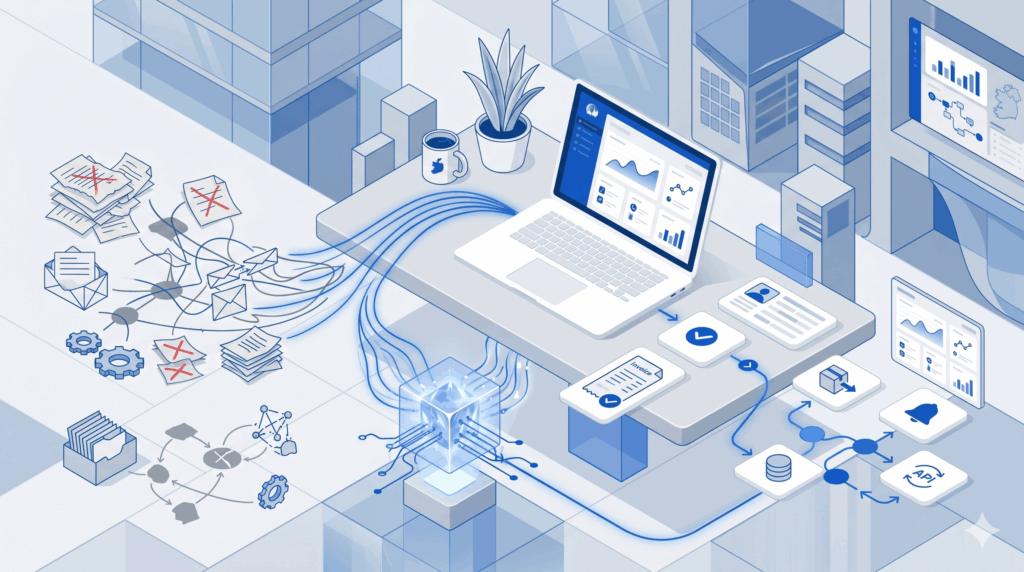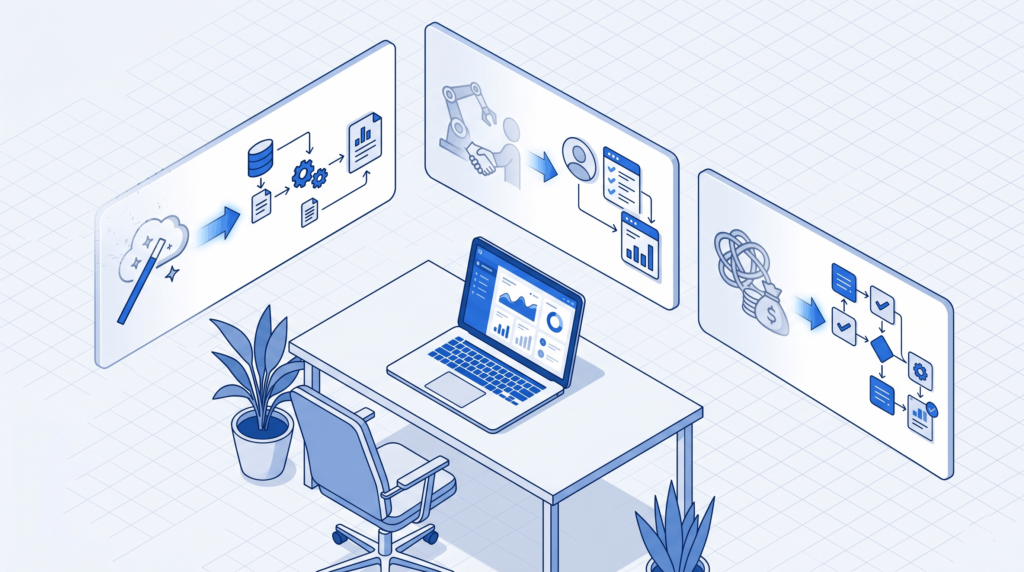
How much time is your team spending on work that should not need human attention at all? If you are chasing invoices, copying data between systems, answering the same customer questions, or moving jobs from one spreadsheet to another, you are already feeling the pressure that intelligent automation is meant to solve.
For many Irish SMEs, the problem is not a lack of ambition. It is that growth keeps exposing the same bottlenecks: too much admin, too many manual handoffs, and too many mistakes that happen because people are doing repetitive work at speed.
This guide shows you what the approach actually means, where it creates the biggest value, how to choose the right processes, and what to avoid so you do not waste money on tools that look clever but do very little. You will also see where automating repetitive tasks in your business can start producing real impact much sooner than most owners expect.
What Intelligent Automation Actually Means
Intelligent automation is more than a task robot. It combines rule-based workflow automation, software integrations, and AI-driven decision support so your business can move information, trigger actions, and handle routine decisions with far less manual effort.
That matters because many businesses confuse automation with simple shortcuts. A basic workflow might send an email when a form is submitted, but this approach can also read the form, classify the request, route it to the right person, and flag exceptions for review.
Automation vs. intelligent automation
Traditional automation is best for predictable jobs. Think of scheduled reminders, invoice approvals, or a system that copies data from one field to another.
Intelligent automation goes further when the process has variation. It can interpret text, detect patterns, and support choices that once needed a person to step in. For Irish SMEs, that difference matters when a process is not perfectly clean, which is usually the case in the real world.
Where AI fits in
AI does not replace the process. It improves how the process responds to messy inputs, such as unstructured emails, scanned documents, or customer messages that do not fit a neat template.
That is why AI automation for Irish startups and SMEs is usually most useful when it is tied to a clear business workflow. The AI is there to support action, not sit in a demo and impress people in a meeting.
A Dublin professional services firm, for example, may not need a full platform overhaul. It may only need automation for document intake, follow-up routing, and status updates. Once you understand that distinction, the next question is where the gains show up fastest.
Where It Creates Real Impact
The best use cases are usually the ones that already consume time every day and create frustration when they go wrong. In Irish businesses, that often means finance, operations, customer service, sales admin, and internal reporting.
A good starting point is to look for tasks with volume, repetition, and clear rules. Those are the jobs that automation can improve without forcing the business to change everything at once.
Common examples include:
- Invoice processing and approval routing, where data can be extracted and checked before a person reviews exceptions. This reduces rekeying and makes cash flow tracking easier.
- Lead capture and sales follow-up, where form submissions, CRM updates, and notifications can be handled automatically. Sales teams spend more time selling and less time copying details around.
- Customer support triage, where incoming queries can be categorised and sent to the right person. That helps teams respond faster without losing control of the conversation.
- Reporting and dashboard refreshes, where data from multiple systems is pulled into one view. Managers get a clearer picture without asking for manual spreadsheets every week.
Imagine an Irish distributor in Cork dealing with dozens of order changes each day. A simple rule-based system would struggle once customers start using different wording, but this approach can read the message, identify the request, and route it correctly while keeping staff in the loop.
That is why process improvement services often sit at the heart of good automation work. The goal is not to automate broken habits. The goal is to remove friction from a process that already matters to the business.
How to Choose the Right Processes and Tools
The most successful projects start with selection, not software. If you choose the wrong process, even a strong platform will feel underwhelming.
Before you automate anything, ask whether the work is repetitive, rules-based, measurable, and annoying enough that people already avoid it. If the answer is yes to three or four of those, you probably have a candidate worth testing.
A practical screening checklist
Use this simple filter before you invest time or budget:
- Look for tasks with clear inputs and clear outputs. If nobody can explain the start and finish of the job, the process usually needs fixing first.
- Measure the time spent each week. A task that takes 30 minutes once a month is not the same opportunity as one that takes 30 minutes fifty times a week.
- Check the error rate. If staff are constantly correcting the same mistakes, automation can protect quality as well as time.
- Identify the owner. Every automated process still needs someone responsible for the outcome, especially when exceptions appear.
- Test for business value. A task may be easy to automate but still have little strategic value, which makes it a poor first project.
For many Irish SMEs, especially those in Dublin, Galway, or Cork, the smartest first move is a small pilot in one department. A finance workflow, onboarding sequence, or customer intake process is often easier to prove than a company-wide rollout. It also makes it easier to explore Irish supports such as Enterprise Ireland, Local Enterprise Offices, the Trading Online Voucher, or the Digital Discovery Programme where they are relevant to your project.
Once the right process is chosen, the project becomes much more about discipline than drama. That is where many teams either build momentum or lose it.
Common Mistakes That Slow Automation Projects Down
The biggest mistakes are usually not technical. They are design mistakes, expectation mistakes, and ownership mistakes.
One common issue is automating a messy process before fixing the mess. If five people handle the same job five different ways, software will simply make the confusion faster. A better approach is to simplify the workflow first, then automate the stable parts.
Another mistake is chasing a big, all-in-one solution too early. Irish businesses often get better results from a focused pilot than from a large rollout that tries to solve everything at once.
Watch out for these traps:
- Starting with the fanciest tool instead of the clearest problem. The goal is business impact, not software theatre.
- Ignoring exceptions. Every real workflow has edge cases, so the design must show where human review still happens.
- Leaving teams out of the process. People adopt automation more easily when they help shape it and understand what changes.
- Measuring success only by speed. Accuracy, visibility, and fewer follow-up emails can matter just as much.
- Treating automation as a one-off project. The best results come from review, refinement, and gradual expansion.
An Irish recruitment business, for example, might automate candidate screening and interview scheduling, only to discover that poorly defined job criteria create inconsistent outputs. Once the criteria are clarified, the automation becomes reliable and the team trusts it.
That is the same reason custom software development in Ireland often pairs well with automation. When the process fits the business properly, the technology becomes far easier to maintain and improve.
How Cozmotec Can Help
Cozmotec helps Irish businesses turn intelligent automation into something practical. The team starts by looking at how your work actually runs today, then identifies the repetitive steps, data handoffs, and approval points that are costing you time.
For many projects, the right starting point is process improvement. That makes sure the workflow is worth automating before any software is built.
Where a process needs new logic, integrations, or a better user experience, custom software development can fill the gap. That combination helps the solution fit the workflow instead of forcing the workflow to fit the tool.
Working with Cozmotec is straightforward. You talk through the problem, they map the process, and you get a clear plan for what to automate first, what to leave alone, and what success should look like. If you’d like to talk through what this could look like for your business, book a free discovery call with the Cozmotec team — no jargon, no obligation, just an honest conversation about where you are and where you want to go.
Frequently Asked Questions
What does intelligent automation mean in simple terms?
Intelligent automation is software that helps your business handle repetitive work, move information between systems, and make routine decisions with less manual effort. It goes beyond basic automation because it can deal with variation, unstructured data, and exceptions more intelligently.
For most Irish SMEs, the practical value is not in replacing people. It is in removing low-value admin so your team can spend more time on customers, sales, and service quality.
How is it different from AI?
AI is the part that helps software recognise patterns, understand text, or make suggestions. The automation combines AI with workflows and business rules so the insight leads to an action.
That means AI may read an email, but intelligent automation decides what happens next. In a business setting, that is usually the difference between an interesting tool and something that actually saves time.
What are the best processes to automate first?
The best first processes are repetitive, high-volume, and easy to measure. Invoice handling, lead routing, customer service triage, and internal reporting are common starting points because they are frequent enough to show value quickly.
If your team is already complaining about the same admin every week, that is often a sign the process is ready for intelligent automation.
Is it too expensive for small Irish businesses?
Not necessarily. The expensive part is usually trying to automate too much at once or choosing the wrong process first. A small, well-defined project can be far more affordable than people expect, especially when it removes work that staff repeat every day.
Many Irish businesses also explore support through Enterprise Ireland, Local Enterprise Offices, the Trading Online Voucher, or the Digital Discovery Programme, depending on the project and eligibility.
How does Cozmotec approach automation projects?
Cozmotec usually starts by mapping the current workflow, finding the friction points, and deciding which steps should be automated, improved, or left manual. That keeps the project grounded in the reality of the business rather than the promise of the tool.
The result is a practical plan that fits an Irish SME’s pace, budget, and team structure.
What Smarter Work Looks Like Next
The real value of intelligent automation is not that it makes businesses look modern. It is that it removes the slow, repetitive work that keeps good people tied up in admin and away from higher-value work. When you choose the right process, keep the first project focused, and design for exceptions, this kind of automation becomes a practical growth tool rather than a tech experiment.
That shift is achievable for Irish SMEs, even if you are starting small and keeping the budget under control. The key is to begin with one process that matters, prove the value, and build from there.
If you are ready to explore the right starting point, get in touch with Cozmotec and talk through the workflow you would most like to improve.
For a related read, the digital transformation roadmap for Irish SMEs is a useful next step if you want to connect automation with a wider plan.