Irish businesses do not usually buy bespoke software because it sounds impressive. They buy it when spreadsheets, manual follow-ups, and patchwork tools start slowing the business down. That is why the real question is not whether custom software is expensive, but whether the current way of working is quietly costing more every month.
For an Irish SME or startup, those hidden costs show up fast: duplicated admin, delayed quotes, missed leads, reporting errors, and staff spending hours on tasks a system should handle. If you are comparing options, our guide to custom software development in Ireland is a useful companion piece to this one.
By the end of this article, you will know how bespoke software pays for itself, where the savings actually come from, what to measure before you invest, and how to judge whether it makes sense for your business in Ireland.
Why Bespoke Software Pays for Itself Over Time
Bespoke software pays for itself when it removes recurring friction from the parts of your business that matter most. The return is rarely dramatic on day one. It builds through fewer manual steps, cleaner data, faster response times, and better decisions made from better information. For an Irish company, that often means replacing a handful of disconnected tools with one system that matches the way the team already works.
The easiest way to think about it is this: off-the-shelf software charges you to adapt your business to the tool, while bespoke software is built to fit your process. That fit matters when your sales flow, operations, or customer service needs are not standard. A strong custom build does not just add features; it removes waste.
The payback is usually spread across several areas
Bespoke software rarely pays back in one line item. More often, the value shows up in five places at once:
- Time saved by staff who no longer copy data between systems or chase approvals manually.
- Fewer costly mistakes because information is entered once and reused across the process.
- Faster customer response times, which can improve conversion and reduce missed opportunities.
- Better reporting, so managers spend less time gathering numbers and more time acting on them.
- Easier scaling, because the system can grow with the business instead of forcing a rebuild later.
When those gains are combined, the monthly saving often becomes more visible than the original build cost. That is why the payback conversation should focus on workload, risk, and growth, not just the invoice. Once you look at the numbers properly, the cost-benefit picture becomes much clearer.
The Real Cost-Benefit Breakdown for Irish SMEs
The best cost-benefit breakdown starts with the full cost of doing nothing. Many Irish SMEs compare bespoke software against a licence fee and stop there. That misses the real price of inefficiency: staff time, rework, errors, delayed service, and the opportunity cost of not moving faster than competitors.
A practical evaluation should look at both direct and indirect savings. Direct savings include admin hours, third-party tools you can retire, and support overhead. Indirect savings are just as important: fewer service issues, better retention, stronger margins, and less dependence on one person who knows how the current process works. In busy Irish businesses, that knowledge risk is often underestimated until someone leaves.
A simple way to estimate value
You do not need a complex spreadsheet to get a meaningful estimate. Start with a few honest questions:
- How many hours per week does your team spend on repetitive work that software could automate?
- How often do errors or missed handoffs create extra work, lost revenue, or customer frustration?
- Which tools overlap, and which subscriptions could be removed after a proper system is built?
- What happens to sales or delivery speed if the process is 20% faster?
- How much time does management spend compiling reports instead of acting on them?
That exercise often reveals that bespoke software is not competing with free manual work. It is competing with hidden cost. For many businesses, the most expensive part of the current setup is not software at all. It is the time your team loses every week while trying to keep broken processes alive.
For Irish founders and directors, this matters because cash flow is not unlimited. The right project should pay for itself through a mix of time savings, lower operational drag, and better decision-making. When that happens, the cost-benefit case becomes easier to defend internally and easier to measure after launch.
Where the Savings Come From in Daily Operations
The strongest return usually comes from everyday operations, not big dramatic features. A system that saves five minutes ten times a day is often more valuable than a flashy dashboard nobody checks. That is why bespoke software works best when it targets real workflows: quoting, onboarding, scheduling, CRM updates, approvals, inventory checks, or internal reporting.
Automation removes repetitive admin
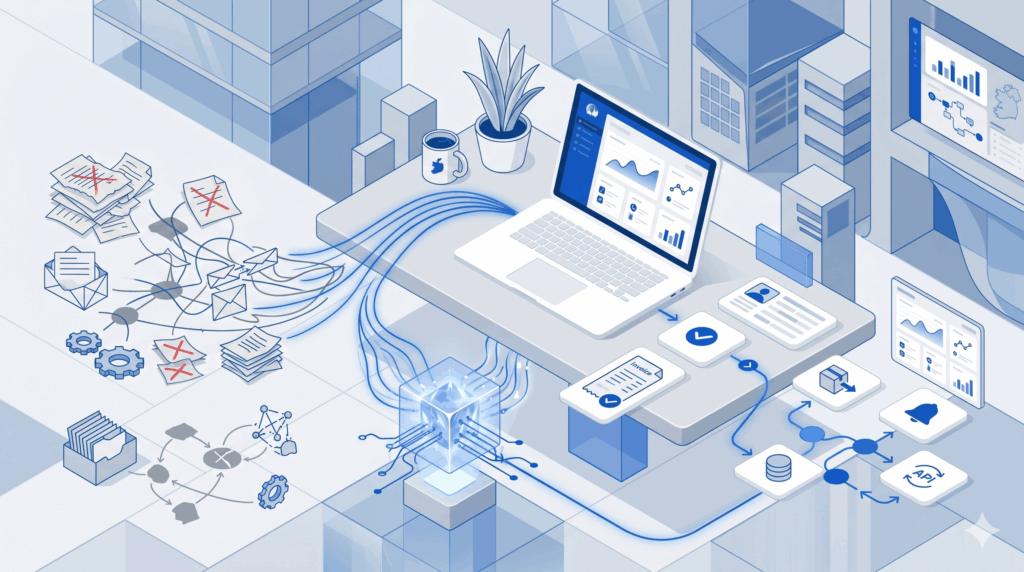
When a process is repeated often, small delays add up quickly. A team member manually re-entering lead data, sending reminders, or updating spreadsheets can easily lose several hours every week. With the right system, those tasks can be automated or reduced to a single review step. This is where a well-planned approach to automation makes a visible difference to margins.
Better process design reduces friction
Sometimes the problem is not the software itself but the process underneath it. If a business has three approval steps where one would do, or six fields that no one uses, the system will still feel heavy. That is where process improvement matters, because the biggest savings often come from simplifying the workflow before building anything new.
For Irish businesses in Dublin, Cork, Galway, and beyond, this is especially relevant when teams are growing faster than their systems. A process that worked for five people can become a bottleneck at twenty. Bespoke software pays for itself by removing those bottlenecks before they become expensive enough to slow growth.
Data becomes usable, not just collected
Another hidden benefit is cleaner reporting. Many businesses already collect plenty of data, but it lives in separate tools and spreadsheets. Bespoke software can bring that information together so owners and managers can see what is happening in real time. That means quicker decisions, less guesswork, and fewer end-of-month surprises.
When software is designed around the way the business actually operates, the savings show up every day. That is the difference between a tool you tolerate and a system that genuinely earns its place.
When Bespoke Software Is the Smarter Investment
Bespoke software is not the right answer for every problem. If your process is simple, stable, and standard, off-the-shelf tools may be enough. The smarter investment is usually the one that matches the complexity of your operation, not the one with the longest feature list.
A bespoke build makes more sense when one or more of these are true:
- Your team keeps adapting to the software instead of the software supporting the team.
- You rely on spreadsheets, manual handoffs, or duplicate data entry to keep things moving.
- Your workflow is a competitive advantage and needs to be protected or improved.
- You need the system to connect with existing tools, customer data, or internal reporting.
- Growth will create more mess, more admin, or more risk unless the process is fixed now.
For Irish startups, the timing can matter as much as the idea. A smaller, well-planned build can be a better use of funds than paying for multiple tools that never quite fit. It is also worth considering support options and funding routes, such as Enterprise Ireland programmes or local digital supports, when planning the project scope.
The important point is this: bespoke software should solve a measurable business problem. If it does that well, it stops being a cost centre and starts behaving like an asset.
How Cozmotec Can Help
Cozmotec helps Irish businesses turn messy, manual workflows into practical systems that save time and reduce mistakes. If your team needs a tailored solution, custom software development is the core service that brings the whole idea together. The team starts by understanding the business problem, then shapes the build around the workflow you actually use, not a generic template.
If the bigger challenge is that the process itself is too clunky, process improvement helps identify where the real friction sits before any build begins. That matters because the best software projects often begin by simplifying what already exists. In practice, the result is a clearer process, a leaner system, and a solution that feels easier for the team to adopt.
If you’d like to explore what’s possible for your business, book a free discovery call with the Cozmotec team – no jargon, no pressure, just an honest conversation about your goals.
Frequently Asked Questions
How do I know if bespoke software is worth it for my business?
Bespoke software is worth it when a repeated business problem is costing time, money, or customer satisfaction every week. If staff are copying data, chasing approvals, or working around clunky tools, the value is usually there. The clearest sign is when the same manual tasks keep coming back and there is no simple off-the-shelf fix. In that case, bespoke software pays for itself by removing the repeat cost.
Is bespoke software more expensive than off-the-shelf software?
At the start, yes, bespoke software usually costs more than a standard subscription tool. Over time, though, the comparison changes because you are not paying for features you do not use, duplicate subscriptions, or ongoing workarounds. For many Irish SMEs, the real question is not upfront price but total cost over 12 to 36 months. That is where a proper cost-benefit breakdown becomes useful.
What kinds of Irish businesses benefit most from custom software?
Businesses with repeatable processes, growing teams, or lots of manual admin usually see the strongest return. That includes service companies, logistics firms, sales teams, recruitment businesses, and startups that need a process to scale cleanly. Irish SMEs also benefit when they need systems that fit local workflows, reporting needs, or integration requirements. In those cases, bespoke software is often less about luxury and more about control.
How long does it take for bespoke software to pay for itself?
There is no single timeline, but many businesses start seeing value as soon as the system removes enough manual work to free up time every week. The payback period depends on how often the process runs, how many people use it, and how costly the current inefficiencies are. A project that replaces daily admin or repeated errors can justify itself much faster than one solving a rare problem. The key is to measure the savings from day one.
Can Cozmotec help even if we are not technical?
Yes. Cozmotec works with non-technical founders, managers, and SME owners who need a clear business answer rather than technical jargon. The team helps translate the problem into a practical plan, then builds around the process that matters most. That makes it easier to decide whether bespoke software, automation, or process improvement is the right move. It also keeps the project grounded in business outcomes.
Final Thoughts
Bespoke software pays for itself when it removes repeat work, cuts avoidable errors, and helps your team move faster with less friction. The real return is rarely just one saving; it is the combination of time, accuracy, visibility, and scalability. For Irish SMEs, that can mean a stronger operation now and fewer growth headaches later.
The best next step is to look honestly at where your business loses time every week and ask whether a better system would fix the root cause. Once you do that, the decision becomes far clearer.
Whether you are still comparing options or ready to move forward, the Cozmotec team is here to help. Get in touch with Cozmotec and talk through what technology could change in your business.
You may also find our guide on our work and case studies useful as a practical next step.